Job vacancy: Software Engineer

Position ID: Software Engineer 1 Hours: Full-time Location: Los Baños, Laguna, Phils. Salary: Commensurate with required qualifications Key Roles and Responsibilities Quantitative Aquatics, Inc. seeks a Software Engineer from a pool of local professionals with the following responsibilities: program dynamic webpages for information systems maintained by Q-quatics (e.g. FishBase, SeaLifeBase),…

Continue reading

Surprisingly narrow combination of traits in fish species

A simple framework for the exploration of functional biodiversity

The world’s waterbodies are filled with predatory fish feeding on other animals from zooplankton to squid and other fish, while “vegetarian” or herbivore fish are rare, new research has found. By developing a framework to better understand aquatic biodiversity, an international team of researchers has analyzed the key traits –…

Continue reading

21st International FishBase and SeaLifeBase Symposium: Second Announcement

FishBase (www.fishbase.org) is the largest global information system on fishes. It provides encyclopedic information on all described fishes and includes many tools for scientists in a large array of ichthyological disciplines. With about 700,000 visits per month, it is the most successful database on any group of living organisms.  SeaLifeBase…

Continue reading

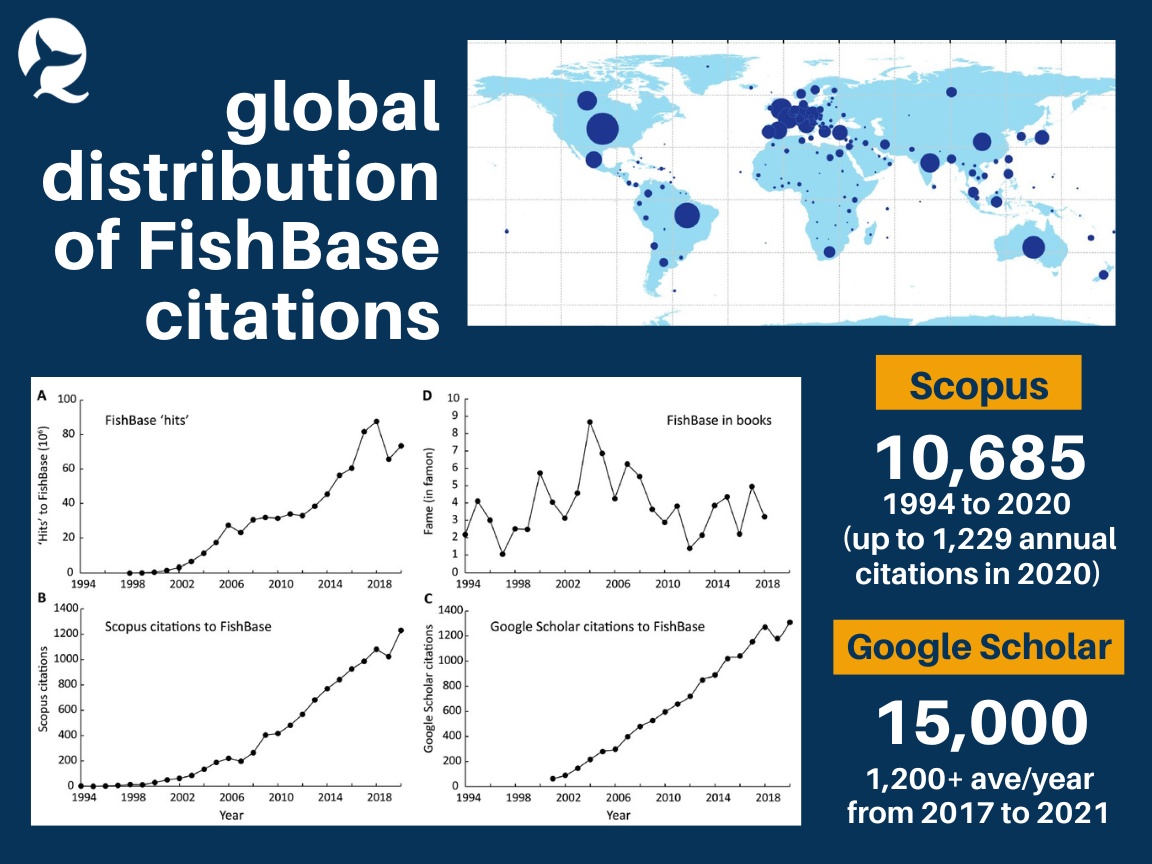
FishBase: A citation powerhouse and essential resource in dealing with global issues

FishBase Citation Analysis

In over 30 years of continuous operation and development, FishBase is now the largest, most extensively accessed and one of the most highly cited public resources in the history of scientific research, a new study reveals. In a paper published in the special edition of Cybium exclusive for FishBase, a…

Continue reading

Large fish more vulnerable to climate change-induced fish kills

Climate change-induced droughts and fish kills affect larger fish more severely than smaller individuals, according to new research. In a paper published in Environmental Biology of Fishes, researchers from Leiden University, Sportvisserij Zuidwest Nederland and the Sea Around Us initiative at the University of British Columbia compared evidence from drought-induced…

Continue reading

2023 FishBase and SeaLifeBase Symposium: Call for Abstracts

Thirty years and numerous upgrades since inception, FishBase is now the largest and most widely accessed global online information system on fish, providing unrestricted and quick access to key information –morphology and physiology, names, genetics and aquaculture, trophic ecology, reproduction and life-history traits, population dynamics, fish as food, fish pictures,…

Continue reading

Oman embassy delegates visit Q-quatics on World Oceans Day

World Oceans Day serves as a unifying occasion for individuals from all across the globe to gather and celebrate the value of the oceans. For Q-quatics, this took on profound significance as they embarked on a momentous journey, engaging with esteemed delegates from the Embassy of the Sultanate of Oman…

Continue reading

WOD 2023: Global aquatic information hubs for ocean conservation

Every year, on June 8th, people around the world come together to celebrate World Oceans Day. It is a poignant reminder to all of the vital role that oceans play in our daily lives. Covering 70% of the earth’s surface, they serve not only as the Earth’s lungs –producing a…

Continue reading

An integrated ‘ABC’ toolbox for updating European stock assessments

In a five-day workshop organized by the EcoScope project at the Fisheries Research Institute (FRI) in Kavala, Greece from May 1st to May 5th of 2023, members of the Project Executive Board and International Advisory Board of EcoScope were joined by ten partners under Work Package 5: Assessing the Ecosystem…

Continue reading

Keep Growing – Fish’s growth is not reduced by spawning

Contrary to what is stated in biology textbooks, the growth of fish doesn’t slow down when and because they start spawning. In fact, their growth accelerates after they reproduce, according to a new article published in Science. The paper is a technical comment by Dr. Rainer Froese, senior scientist at the Geomar Helmholtz…

Continue reading