Daniel Pauly and Deng Palomares present to the EU Parliament’s Committee of Fisheries

  Participating to present the “Role and impact of China on world fisheries and aquaculture”, a report commissioned by the European Parliament’s Committee of Fisheries, Dr Daniel Pauly (FishBase pioneer and the Sea Around Us‘ Principal Investigator) and Dr Ma. Lourdes ‘Deng’ Palomares (Sea Around Us’ Program Manager and the…

Continue reading

New collection of standardized geophysical and environmental marine data of for ecological and ecological-niche modelling

This new publication “Global-scale parameters for ecological models” in Scientific Data of Nature.com pertains to the collection of environmental data produced as a result of a collaboration between the National Research Council (CNR) of Italy and Quantitative Aquatics, Inc. (Q-quatics) for the EcoScope Project, specifically under Work Package 4: Climate…

Continue reading

Most coral reef sharks and rays may be at risk of extinction, UBC study says

Nearly two-thirds of coral reef shark and ray species worldwide are threatened with extinction, a new study in Nature Communications co-authored by the Sea Around Us’ Project Manager and Q-quatics’ Science Director Dr. Maria ‘Deng’ Palomares shows. The results suggest that the extinction risk of coral reef sharks and rays,…

Continue reading

The future is bright for FishBase and SeaLifeBase

.. this unassuming website is the gateway to one of the most-cited resources in the last two centuries of modern science – a database on fish. ‘Breathing new life into FishBase and SeaLifeBase’, blog by Neil Palmer (WorldFish), gives an overview of the FishBase Project as a powerful and widely-used…

Continue reading

New bandfish species discovered in deep sea collection from eastern Philippines

  In a new publication, ichthyologists from Taiwan and the Philippines, described a new species of bandfish, Owstonia aurora Liao, Reyes & Shao 2022. The specimens used to describe the species were collected east of Aurora province in Northern Luzon at depths of over 300 meters during the Aurora 2007…

Continue reading

Only ‘good fish’ belongs to the table

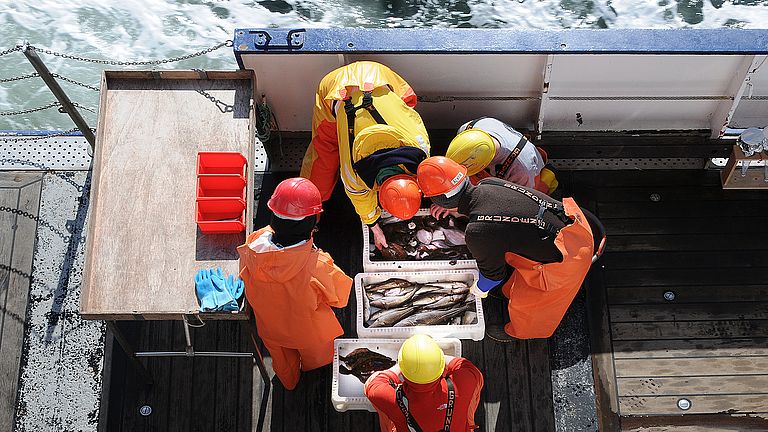
Research fishing haul aboard the ALKOR in Eckernförde Bay.

An annual list of marine fish and bivalves that serves as a guide to German consumers on what they can purchase and eat with a clear conscience –those currently with large and healthy population sizes and are fished sustainably, or in short, the ‘good fish‘, was recently published as a…

Continue reading

Expecting aquaculture to ‘feed the world’ may be unrealistic, UBC-led study shows

Trends in global aquaculture growth rates reveal that the 101 million tonnes of farmed fish intergovernmental bodies expect countries to produce by 2030 may be unrealistic. A new study led by researchers at the University of British Columbia presents evidence suggesting that global aquaculture growth rates peaked at 14.1 per cent in…

Continue reading

Ecosystem-based fisheries management restores western Baltic fish stocks

Marine scientists from GEOMAR Helmholtz Centre for Ocean Research Kiel (Germany), the German Federal Agency for Nature Conservation (Bundesamt für Naturschutz, BfN, Germany) and the Institute of Biosciences and Bioresources at the National Research Council (CNR) of Italy teamed up to test and predict how different marine life in the…

Continue reading

A fisheries scientist in Penang, Malaysia

By Daniel Pauly In early September 2022, I found myself on the island of Penang, Malaysia, where WorldFish, an international research center focusing on tropical fish culture, is headquartered. WorldFish is the new name of the International Centre for Living Aquatic Resources Management (ICLARM), previously located in Manila, the Philippines,…

Continue reading

New publication: A new method to assess ecosystem vulnerability and protect biodiversity

In the new publication “A functional vulnerability framework for biodiversity conservation”, published in Nature Communications on the 1st of September 2022, Q-quatics provided occurrence records for over 4,000 marine species that the AquaMaps team has verified. These are made up of georeferenced occurrence data, primarily from GBIF and OBIS, that have…

Continue reading